
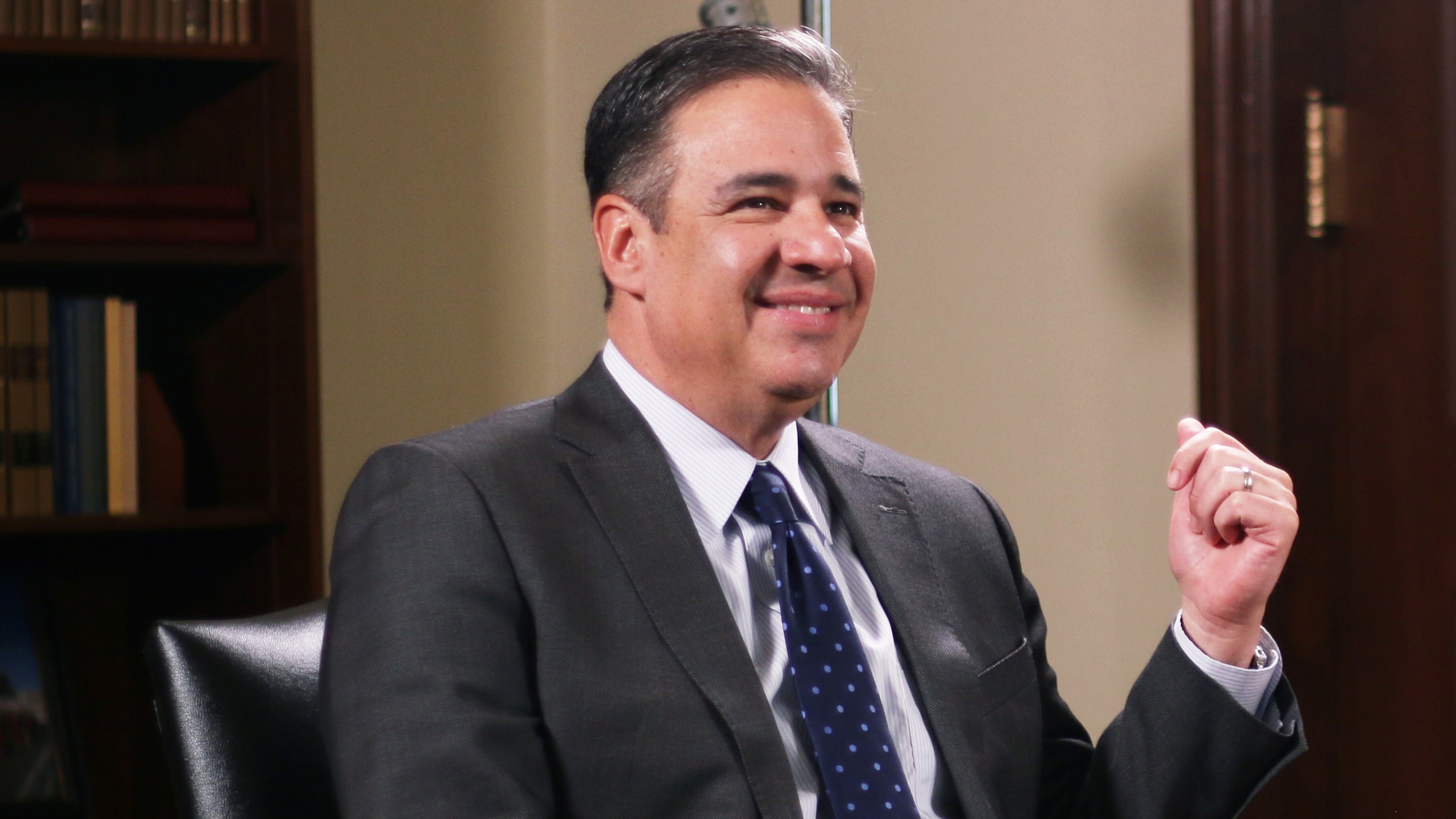

It’s been nearly a year since Idaho’s new constitutional officers were sworn in, including Attorney General Raúl Labrador, the state’s first new attorney general in more than two decades. Idaho Reports visited Labrador at his capitol office this week to discuss his first year as Idaho’s chief legal officer, his outlook on the job, and the high-profile cases his office is currently litigating.
Read: A Conversation with Attorney General Raúl Labrador
This transcript has been lightly edited for clarity.
Melissa Davlin, Idaho Reports:
Thanks so much for joining us this week. How do you think your first year in office went?
Raúl Labrador, Idaho Attorney General:
It’s been amazing. It’s been a great experience. We’ve been able to change the culture of the office. We’ve been able to make a lot of changes in many of our divisions. I think we’re being more responsive to the people of Idaho. I think it’s been a tremendous year and I’m honored to be the attorney general for the people of Idaho.
Davlin:
You mentioned culture in the office. What do you mean when you say that you’ve changed the culture in the office for the better?
Labrador:
Well, a lot of different things. I think, because the prior administration was here for so long, for 30 years, there’s some good things that come from longevity, but sometimes there’s some things that are not as good when you have somebody in the same office for such a long time. And when I came in, the first thing I told my attorneys is that our job is to make sure that we’re not defending bureaucracy, that we’re defending the laws of the state of Idaho, that we’re making sure that when we talk to our clients – which are, number one, the people of Idaho, but also the agencies and the different elected officials – that we do what’s necessary to let them know what the law allows them to do and does not allow them to do. I had seen as a prior legislator and as a new attorney general that too many times, many of the attorneys here were just justifying whatever their pals in the bureaucracy wanted to do instead of actually telling people the hard nos. That sometimes you have to say no, that the law does not allow you to do that.
Davlin:
Do you think they were defending their pals in these institutions, or was it just a different interpretation of the laws and administrative rules of the state?
Labrador:
Well, I think sometimes it was just defending your pals. I think when you look at, you know, when you have some cases where I would ask, tell me what your interpretation is of the law – because I have no problem disagreeing with people on interpretation. I think, you know, the old joke, you put two attorneys in a room, and you can get three or four different opinions, right? And I don’t have any problem disagreeing with people in the interpretation of the law. It’s when I would say, tell me what your interpretation of the law is. And then they would give me their interpretation and when I said, what are you basing that on? ‘I don’t have to; I don’t have to say that to you. I don’t have to justify that.’
You have to say, no, actually, I’m your boss and I’m the person you need to justify it to. I may actually disagree with you – and that’s okay – but if you don’t even have legal analysis as to why you’re doing something and your answer is, because that’s the way it’s always been done, that’s not a legal opinion.
Davlin:
You touched on this a little bit. Let’s talk about your philosophy when it comes to who you’re defending in this office. Is it the people of the state of Idaho? Is it the state agencies? Is it a combination of both? And if so, how do you balance those?
Labrador:
Absolutely. It’s a combination of both. So, I’m the attorney general for the state of Idaho and my number one duty is to represent the state of Idaho. And as you know, in the Constitution, the state of Idaho is the people of Idaho, so I need to make sure that I ensure that I represent the people of Idaho. But I also have a legal responsibility and a statutory responsibility to represent the agencies. But that’s different than agency heads or bureaucrats. I’m not the personal lawyer for the directors of the different agencies. I’m the lawyer for the agency.
So, I’ll just give you a simple example. If I’m a new lawyer who’s representing a corporation, and I go in as the new lawyer for the corporation and I realize that the members of the board of the corporation are doing things that are not right. I don’t have a duty to the members of the board or to the different people who work for the corporation. My duty is to the board. My duty as an attorney is to the people of Idaho and to the agencies – to ensure that the agencies are complying with the laws of the state of Idaho. And I think that had been lost a little bit over the last 20 or 30 years.
Davlin:
This came to a head earlier this year when you started an investigation into the Idaho Department of Health and Welfare over their use of ARPA funds that were meant to address learning loss in school aged children. Instead, some of them allegedly went to preschool programs or for children who were younger. That case was dismissed without prejudice. But it begs the question. A lot of the people in the Department of Health and Welfare were relying on an opinion from a deputy attorney general from the prior administration who continued to work here when you took office. Should these agencies rely on the opinions of deputy attorney generals?
Labrador:
Melissa, can I correct you for a second?
Davlin:
Please.
Labrador:
Absolutely, because I think everyone has gotten this wrong. They were never relying on the opinion of the attorney general’s office. They performed their duties as bureaucrats, and they did something that the legislature thought was wrong. The legislature said that they were going to start investigating, and then the director and the governor’s office asked for a legal opinion after the actions had already occurred. So, if you read the legal opinion – and I invite everybody to read it – the legal opinion from the deputy attorney general just had no analysis other than we think it’s okay what the Department of Health and Welfare did. And I just looked, and I said, well, what are you basing this on, number one. And number two, it wasn’t something that the agencies were relying on because that would be totally different. Even if the analysis was wrong but the agency had relied on that analysis, then I have a problem. Because then, you know, my problem is then I have to go to my attorneys and say you need to give better analysis in the future. But I realize that the agency is relying on what my attorneys did. That’s not what happened. This is what I call a CYA letter. You know what a CYA letter is.
Davlin:
Cover your butt.
Labrador:
Cover your butt. It’s like, after they committed the wrong acts, they went to their attorney to say, hey, can you save us here and give us a legal analysis that covers us in the actions that they had already done.
Davlin:
Why go this route, though, instead of relying on a state audit to uncover any improprieties or inappropriate actions?
Labrador:
Because I didn’t know. The legislature came to me. We had the chairs of JFAC say, look, we’ve had this problem for many years where we write a law in the state of Idaho and Health and Welfare decides that they don’t have to follow it. They don’t have to do anything according to the law. And they keep relying on these federal guidelines. And I know this can be a little bit complicated, but federal guidelines do not trump state statutes. Federal statutes can trump state statutes. But federal guidelines never trump state statutes. And they said, they have done this again and again, where they claim that the federal guidelines trumped state statutes, and I said, well, let me look into this.
So, I was not investigating anyone specifically. I just issued what are called CIDs, which are civil investigative demands. And what this did is it went to anybody who received the money or anybody who was participating in giving the money to these different entities. I just asked them for information to come to me, because I knew something had happened that was wrong. I didn’t know if it was a mistake, if it was illegal, if it was just misunderstanding. And I just wanted to find out what exactly happened, because it can be anything from a nothing-burger to a crime, what was happening. And we just needed to investigate. We knew that the legislature was also going to investigate this, but we wanted to make sure. The CIDs were just issued to make sure that the evidence was preserved, because, as you know, there’s no preservation statute in this state. So, if all of a sudden there’s an investigation, people could have hidden records, they could have deleted files. And I just wanted, it was sort of a preservation-of-documents letter. And these things are done on a routine basis. I do this all the time in the attorney general’s office. Federal agencies issue CIDs all the time. And I was not the one who started the litigation against the agency. It was the director of the agency who started the litigation against me. So, I didn’t even have a conflict when this whole thing started. It was where the director decided that he was going to fight the CIDs instead of just responding to the CIDs, like many of the other people who received the CIDs did.
Davlin:
You said this could be anything from a nothing-burger to a crime. What do you think, now that you are more into the investigation process?
Labrador:
Well, clearly LSO thought that it was something more than a nothing-burger, that something clearly had happened that was wrong. And that’s why we withdrew the CIDs, because now we have evidence of wrongdoing. And now we have started, through a special assistant attorney general, we have started a criminal investigation. And we’re going to see, and we haven’t made a determination yet. And again, we don’t know who, if anybody, committed a crime or committed a civil violation. All we’re doing is we’re investigating right now.
Davlin:
The Department of Health and Welfare is asking that your office pay more than $119,000 in legal fees because they had to hire an outside counsel to defend them in this. Are you going to pay that?
Labrador:
I am not. And it would’ve cost them $100 to just comply with the CIDs. If you look at the report from the legislature, they said that they also had a very difficult time getting Health and Welfare to respond to their investigation. So, there’s a pattern here of misusing the law, of not complying with the law, and then to fight as much as you can to just even give proper information.
I mean, the whole basis of government, and free and open government, is to ensure that the agencies and the entities are providing the public the information that they need. And that was all I was doing. I was trying to get information for the public, because the legislature – who, remember, is also my client – and that’s one of the biggest issues that people don’t seem to understand. I have a lot; I wear a lot of hats as attorney general. I have so many different clients, and the statutes are the ones that determine whether I can or cannot do certain things. And I’m just following the law. I’m just complying with the law and doing what the statutes say that we should do. I think, unfortunately, in the past, we didn’t have such a robust investigation and analysis and enforcement of the law here in this office.
Davlin:
You’re also suing the State Board of Education over alleged open meeting violations from meetings predating the public reveal of the University of Idaho’s planned acquisition of the University of Phoenix. First of all, the lawsuit. Was that the only way to fix that open meeting violation error? Or did you have other concerns with that planned acquisition?
Labrador:
That’s a great question. So, number one, the lawsuit, unfortunately, was the only way that I could do it. Because when we found out, when we realized that there was an open meeting violation, the attorney general’s office under statute has to enforce the open meeting violation laws. But we only have 30 days to enforce that. So, I found out on like day 28, or we figured out on like day 28 that that we had this violation. So, what I did is I picked up the phone and I told the board, hey, we need to file this lawsuit because we’re coming up on a deadline. In fact, the day that I called them was the day of the deadline. And I said, well, You guys have seven days. We’re going to file the lawsuit but we’re not going to serve you the lawsuit. And we told them that we were not going to serve it for 24 hours. We actually ended up not serving it for seven days. If you guys want to just cure the violation – which is, as you know, very easy to do – I will dismiss the lawsuit.
We waited a week to serve them with the lawsuit. And all of the sudden, I’m getting sued by them, because they don’t want to comply with the open meetings laws. And that’s where this became, again, in both cases it’s the same action. It’s the agency that decides that they don’t want to comply with the law, or they disagree with me whether they’re complying with the law, that decides to engage in the fight. It would have been very simple for them to just do what was necessary to cure the violation. I have actually been in meetings where there have been violations of meetings law, and it takes us 5 minutes to cure that. It’s not a big deal. It’s a mistake. Sometimes it’s embarrassing, but it’s something that you can just cure and fix it. It does not take hundreds of thousands of dollars in legal fees to fight these things.
Davlin:
You brought this up a couple of times, especially when it came to the Department of Health and Welfare, that that you’ve been critical of some of the deputy attorneys general who stayed on from the prior administration. Is that criticism fair? You know that this job is often thankless for a lot of these civil servants. Is a different philosophy or approach to the job, does that warrant that kind of public criticism?
Labrador:
Well, it’s public criticism when they criticize me first. I never throw the first stone. It’s something that they came in, some people decided that they were going to criticize me, that they were going to be very negative about the work. I have kept most of the people that were here under the prior administration. We have hired a lot of new people, but we also kept most. At least half, if not more, of the people that are working in the office are prior employees of the attorney general’s office, and they’re doing a tremendous job.
I actually think the culture is better. I think there’s a new sense of excitement. I think there was some trepidation at the beginning, like there would be at any shift in in organizational leadership. But I think people are realizing that I’m trying to do what’s best for the people of Idaho, that I want to work hard. Remember, the first thing that I did as attorney general is I filed a budget asking for a salary increase for every employee in the office. So, it’s not like I came in and said, no, you guys are not doing a great job. I actually came in and said, I want all of you to receive a salary increase, because I do agree with you that it’s a thankless job to work for the government. Countless hours and low wages, where they could be making a lot more money in the private sector. I think it is very important that we celebrate them, and we work with them.
But what I will not put up with is insubordination. What I will not put up with is somebody claiming that I, as the attorney general, don’t have a right to know the analysis of what they were trying to say. It’s okay if we disagree. I mean, I disagree with people all the time, but I have a right and a responsibility to know why is it that you’re coming to this conclusion on a legal matter.
Davlin:
I wanted to ask you about the multiple cases involving abortion and challenging the state’s abortion ban, that your office has had to defend. When you ran for office, you said “There’s ways to draft abortion laws that will survive constitutional challenges and the ways that won’t survive.” After defending this law that passed when you were not attorney general, would you have crafted this law differently?
Labrador:
You know, I will not answer that question just because it will be used against me in a court of law. But I think it’s important that that we defend what the legislature is doing. And what we have done really well – and I think the legislature has done a beautiful job of drafting some of these laws – but I have done something that is very different than the prior attorney general. When they came to me with new laws, that I thought were maybe suspect or maybe something that that should not be passed by the legislature, instead of drafting an opinion that can be used by our legal opponents in court I’ve just picked up the phone and I’ve just said, hey, Representative or Senator, would you consider maybe making some changes to this legislation so I can then defend it in the courts?
And what I can tell you is that every time I have made that suggestion, they have complied. Because I have not tried to embarrass them publicly. Because sometimes when you issue those legal opinions in public and you say, well, this bill proposed by Representative such-and-such is so bad that its unconstitutional, how do you think that representative is going to react? They’re not going to react very well. But if I pick up the phone and I say, hey, Representative or Senator such and such, would you change this word or this phrase, or delete this paragraph? Every single time that I made that proposal, they have said, sure, why not?
Davlin:
If you take that opinion out of writing, is that antithetical to some of the government transparency issues that you’ve brought up in other cases?
Labrador:
No, because my duty as attorney general is to ensure that I give them legal advice based on what their duties are as legislators. There’s nothing in the law that says that I have to give legal opinions as to the constitutionality of a statute. In fact, I’ve always thought – even when I was a state legislator many years ago – I’ve always thought that they had a separation of powers issue where you have the executive telling the legislative branch that something was unconstitutional. When I was in Congress, I didn’t go to the Department of Justice to ask if my statutes were constitutional or not constitutional. We had attorneys in the House who were our attorneys, that we would ask them, can you help us draft this legislation? Can you tell me if the any legal conflicts that I have? These were things that were for the benefit of the legislator. This relationship where you have one attorney from the executive branch telling a legislative branch member whether their legislation is valid or not, I think actually violates the separation of powers.
Davlin:
So, to make that very clear, you support the legislature having its own attorney in the future?
Labrador:
I do, and I did when I was a legislator, and I continue to do it. But, you know, there are valid issues when they come to me, and they say that they want to write a piece of legislation. And they just want to know, for example, whether they need to put it in the constitution or in a statute, you know, when it deals with some of the agencies that are created in the constitution. That’s a very valid question for the attorney general: Is the best way to draft this is to put it in the constitution versus the statute? But to determine whether something is constitutional or not, they’re just as capable as I am to determine whether something is constitutional, and their lawyer should be capable of doing that.
Davlin:
Bringing it back to abortion, there are several anti-abortion legislators who have said they believe that the current law needs to be tweaked. Current litigation aside, what would you tell them to keep in mind?
Labrador:
I always tell them to look at what the Supreme Court has said, both state and federal Supreme Court, and to ensure that they comply with whatever guidelines they receive from the Supreme Court. Because the Supreme Court, both state and federal, does a good job of letting you know where they’re headed with their analysis and jurisprudence. So, that’s where I think I’m most helpful, is when I can say, you know, I just wouldn’t write it the way that you’re writing it here. I would maybe write it a different way, or I would take out this line or this paragraph, because I know where the Supreme Court is going, or at least – I don’t know, I shouldn’t say I know – but that I can suspect or imagine where the Supreme Court is going. I think that’s where we can be most helpful.
Davlin:
One more question on abortion. This is playing out across the country in states with similar legislation and laws on the books, including in Texas, where Attorney General Ken Paxton said that he gave a warning to doctors and hospitals, saying if you provide abortions for health-threatening pregnancies – not life-threatening, but severely health-threatening – that we will prosecute you. Do you agree with Attorney General Paxton? Would you prosecute a doctor who provided an abortion for a severely health-threatening pregnancy?
Labrador:
So, we have two differences from Texas. Number one is that, unlike Ken Paxton, I don’t have prosecutorial authority in these cases. He’s actually the chief, not just a chief legal officer, but he’s also the chief law enforcement officer of the state. I’m not the chief law enforcement officer of the state, so I don’t get to prosecute anyone unless the local prosecutors decide to refer a case to me.
Davlin:
Which does happen sometimes.
Labrador:
It does happen, correct. But it’s a very different analysis because I don’t get to enforce the laws like he does, the criminal law. But number two, I think our Supreme Court, our state Supreme Court, was really clear that this statute was written in a way that the doctor can make a decision based on what they feel is the life-threatening injuries that the female has, that the mother has. And I think it’s pretty broad in the way that it was written. So, it’s very subjective. That the doctor gets to decide, based on his or her professional opinion, if this person’s life is in jeopardy. And so, I think the law is written pretty clearly, and I don’t think there’s any concerns that we need to have about that.
Davlin:
So just to be clear, you believe that there are enough protections for doctors to use discretion in their emergency rooms or in the OB-GYN clinics?
Labrador:
If there’s a life-threatening condition.
Davlin:
I wanted to ask you about executions. There are two that are pending, two men on death row who have been served death warrants. And earlier this year, the state legalized the use of a firing squad because of the shortage of execution drugs that were available. Do you believe Idaho will see an execution within the next year?
Labrador:
I don’t. I think, as you saw in this instance, the moment that Idaho passed that law, that all of a sudden, we were able to get the drugs that were necessary to do lethal injection. And I think, unfortunately, you had some forces that are anti-death penalty that were making it very difficult for pharmacies to provide these pharmaceuticals that are necessary for executions. So, I think as we saw in this instance is going to happen every single time. I think most, now that we have this other option, I think it’s going to be much easier for the state to receive what’s necessary for lethal injection.
Davlin:
Does that mean that the state is using these death warrants and these men who are on death row as leverage to shake loose these lethal injection drugs?
Labrador:
No, what it means is that the state is trying to comply with the law. That the state of Idaho has decided that we’re a death penalty state. The state could decide, the legislature could change this statute, but what we should never allow is these activist groups to get in the way of us enforcing the laws in the state of Idaho.
Davlin:
Idaho administrative rules allow for the attorney general or a representative of the office to be present in the execution chamber. If we get to the point where there is a firing squad execution, are you personally willing to be a witness to that execution?
Labrador:
I think it’s my responsibility. I think I should be there.
Davlin:
Moving on to federal lawsuits, what’s your philosophy on which lawsuits to sign on to?
Labrador:
So, we get tens of lawsuits every week that people ask us to sign on to, and we don’t sign onto all of them. What I look at, is whether we think the federal government in some way is usurping the powers or the sovereignty of the state of Idaho, and if we think it’s something that’s important to the state of Idaho, if it’s something that has a direct correlation to the issues that Idaho is dealing with.
Just today, I had a list of eight cases where we were asked by different states to join in the lawsuits, and I think we signed on to four out of the eight. So, you know, I don’t sign on to every single one. And as you know, I think there’s been some maybe misleading statements out there, when we participate in a lot of these lawsuits. There’s very little work that our office – you know, if it’s another attorney general’s office that is leading the charge, our job is just to read the briefs and make sure that we agree with the arguments. A couple of the cases today were cases that maybe I agreed with what they wanted, but I didn’t agree with the argument that they were making. So, we said, no, we’re not going to join that lawsuit. But it doesn’t take a whole lot of effort or work for the state. Now, there are other efforts where we have actually been leading the fight, and that means that my solicitor general’s office is involved quite actively in those cases.
Davlin:
I’m curious about the reason for signing on to the recent Voting Rights Act amicus brief supporting an Eighth Circuit decision that says private groups and individuals can’t sue under Section 2 of the act, which protects against racial discrimination in voting and redistricting. That decision currently affects only the Eighth District. We’re not in the Eighth District. I don’t believe Idaho has ever had a Voting Rights Act case. Why get involved in that one specifically?
Labrador:
Because that one has a bigger national profile that actually leads to things that could affect the state of Idaho. The Voting Rights Act, and any kind of voting litigation, affects every single state individually even if we have not had litigation in our state. So, that’s an issue that I feel is compelling for the state of Idaho, because whatever is decided in that case will have national ramifications. For example, you know, the composition of the House and the Senate, who the President of the United States is. All of those things are very important, even though they don’t have a direct correlation to Idaho, because we’re probably never going to be sued – I hope – on these issues. I hope I’m not inviting people to do that now. But the result of that litigation will directly affect the state of Idaho.
Davlin:
Moving outside of the attorney general’s office, you’re the former chairman of the Idaho Republican Party. How do you feel about the direction and the state of the party right now?
Labrador:
You know, I always laugh when I hear the media and people outside just talking about how the Idaho Republican Party is divided. They’re always talking about how the Idaho Republican Party is divided. When I was a freshman legislator, if people remember, I was actually the one who helped take out the current chairman at the time of the Idaho Republican Party. I have fought with leadership of my party. It’s always funny when people accuse me of being partisan, because I’m like, I’m probably the least partisan person. I have fought my party probably more often than I have fought the other party on a lot of these issues. There’s always a tension in the party, because we have such a supermajority in the state of Idaho that the real fights happen between the conservatives and the more establishment members of the Republican Party. I think that in some instances it may be a luxury that we have because we have a supermajority. If we had a closer majority, I think there would be fewer of those fights.
But I always think it’s healthy. I think it’s healthy for a party to try to address the issues that they perceive. And I sometimes see that, my friends who are conservative taking things a little bit too far, and I think you see things happen where it ratchets back to a more rational decision or opinion. But I think this tension is always going to happen in the state of Idaho and I don’t think there’s anything unusual about it. What I do think, it’s a little bit ironic, is when people say that the party wants to have Republican legislators that are following what the party wants, and somehow that’s objectionable, but they have no problem with groups like IACI or the Idaho Statesman or others telling legislators what they want to see from legislators. I think it’s healthy. I think if you’re going to say that you’re going to be a Republican, you should explain what kind of Republican you are. It doesn’t mean that we should kick you out of the party. I don’t agree with that. But you should always explain what kind of Republican you are.
Davlin:
I do remember a certain 2014 state convention that you chaired that was a little divisive.
Labrador:
Yes. It was very divisive, yes. And I survived it!
Davlin:
We all survived. One last question. Are you planning to run for attorney general again in 2026, or do you have something else in mind?
Labrador:
I have nothing else in mind. I don’t know what I’m going to do. It’s way too early. I’ve only been doing this job for a year. But it really has been a tremendous honor. You know, one of the things that people don’t ask about is what some of those changes are that we have made. And one of the things I’m most proud of is in our criminal division. My first week in office, I interviewed a bunch of people in the criminal division, and I said, “What do you guys want to see change in this office?”
And one of the things that they raised to me is that in the past, the attorney general’s office had not given assistance to local communities unless they were taking over the cases. This is maybe a little bit hard to understand, but it was “Sure, we’ll help if we can take over the full case,” instead of we were just to assist. And my prosecutors and investigators were saying that that was sometimes detrimental to the state of Idaho. They asked me if I was willing to change that policy, so we can start helping in criminal prosecutions at the local communities. And I said, “Of course, I think that would be wonderful.”
And now we’re helping in several big cases, including the Moscow murders, where my attorneys from the Idaho Attorney General’s office are second chairs in that case. We told them we don’t have to take over the case, we don’t have to take credit for it. But what can we do to assist you? And our attorneys have done a really terrific job. We also changed ICAC and the way that we’re doing ICAC cases.
Davlin:
Internet Crimes Against Children.
Labrador:
Internet Crimes Against Children. And we brought somebody in who’s the new head of ICAC, and we have dramatically decreased the backlog of cases that we had. At the beginning of my administration, we had over 1,400 cases that were in backlog. We’re nearly down to zero right now. There are some really positive things that are happening in the Attorney General’s office, and I’m proud of that.
Davlin:
All right. Attorney General Raúl Labrador, thank you so much for joining us.
Labrador:
Thank you.

Melissa Davlin | Host, Lead Producer
Melissa Davlin is the lead producer and host of Idaho Reports. She has covered the Idaho Legislature since 2012. She also produces for Outdoor Idaho and Idaho Experience. Melissa serves as the president of the Idaho Press Club. She has won multiple awards for her work, including a regional Emmy for her documentary on Chinese immigration in Idaho, Idaho Press Club broadcast reporter of the year for 2015 and 2019, the Idaho Press Club First Amendment Award, the University of Idaho Silver and Gold Alumni Award, and the 2019 Boise State University Enhancing Public Discourse award. She lives in Boise with her husband and children.