
by Idaho Reports staff
For more than a decade, the Idaho Department of Health and Welfare has worked to improve the state’s foster care system, increasing both the number of welfare workers and foster homes, and creating an independent office to review complaints about the system.
Gov. Brad Little appointed Alex Adams in 2024 to head the department, where Adams made foster care his top priority. In 2025, President Donald Trump appointed Adams to serve as the assistant secretary for the Administration for Children and Families at the Department of Health and Human Services.
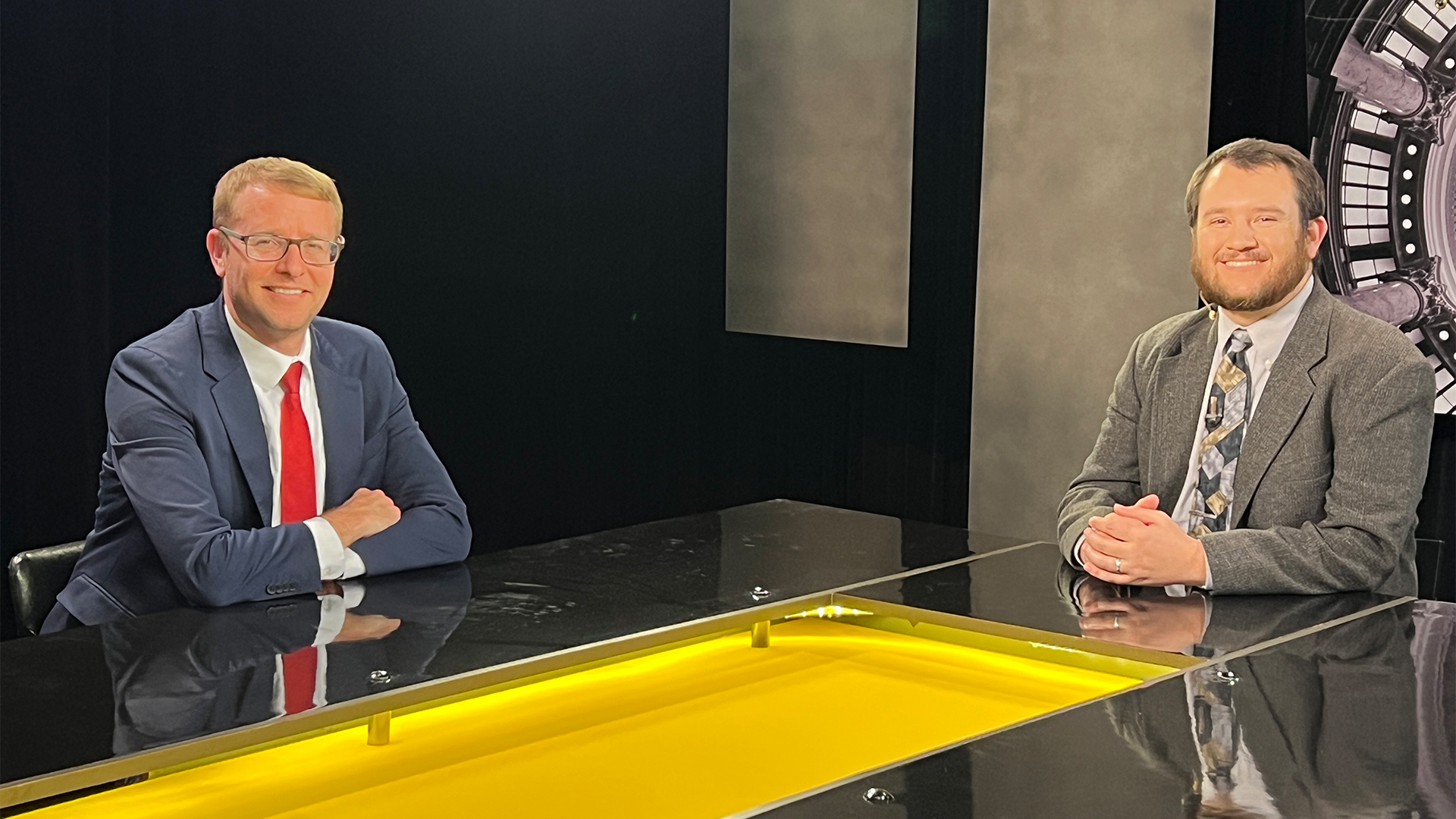
Idaho Reports producer Logan Finney sat down with Adams on December 23rd to discuss his new role in D.C., how he’s pushing other states to adopt some of the foster care changes made here in Idaho, and just how much influence the administration actually has over these state-administered programs.
Transcript: Alex Adams at the Administration for Children and Families
Logan Finney, Idaho Reports: Alex Adams, assistant secretary for family support at the Administration for Children and Families at the U.S. Department for Health and Human Services. Thanks for joining us.
Alex Adams, HHS Assistant Secretary for Family Support: Good to be back in Idaho.
Finney: So, Alex, tell us a bit about your work at HHS.
Adams: Yeah. So HHS is Health and Human Services. I’ve got the “and human services” portfolio. So there’s about 60 programs, more than $70 billion, and it’s a lot of programs folks probably would recognize. Head Start, child care block grant, TANF which is cash assistance, and then child welfare. So adoption assistance, guardianship assistance, and foster care.
Finney: And we also have an executive order that President Trump put out in November. That really has a lot to do with specifically the work that you do in the Administration for Children and Families. Can you tell us a little bit about the Trump administration’s priorities and why they reached out to hire you?
Adams: Well, I appreciate the leadership of President Trump and First Lady Melania Trump, who both signed this executive order. It’s called Fostering the Future. It’s a government-wide, whole-of-government approach to improving foster care with a heightened emphasis on older youth, youth who are aging out of foster care. It’s got a call for a number of different agencies. Mine, the administration for Children and Families. But there’s also roles for Housing and Urban Development, roles for Treasury and others.
In terms of some of the things that we’ll be implementing. One of them is a website for older foster youth to make sure they know what resources are available to them – financial literacy classes, housing vouchers, education and training vouchers – because too many of those go unused and get returned to the US Treasury at the end of each fiscal year. So, something that will be AI-powered and help them understand what is available to them, and help them access it in real time, is one of the biggest things that I’m excited about in there.
Certainly other things. One of the provisions is about reducing the administrative burden, things that are high-cost, low-value. Just based on what we did here in Idaho, in terms of cutting a lot of red tape, you can rest assured I’ll be sinking my teeth into that one quickly.
Finney: You sure have a reputation for that.
One of the issues you tackled here in Idaho before moving to D.C. is something you want other states to follow along with. This has to do with Social Security benefits that go to foster youth. Can you walk us through how that system had worked in the past, and what changes you’re pushing the states to implement?
Adams: If a child’s parents die and those parents had worked, they’re entitled to a Social Security survivor’s benefit and that benefit then passes down to the child. And it might be the last remaining financial resources that a deceased parent can leave their child. However, if a child enters into foster care, the state is now the parent – and 39 states basically take that money from that orphan and say, we’re going to use that to balance our books. It’s wrong. You know, as a former state budget director, I can say it’s a moral issue, not a budget issue.
Finney: So, using money that’s arguably meant to go to the child, to pay for the administrative costs of caring for the child?
Adams: That’s exactly right. Those are costs that the state is legally on the hook for covering for other children. So, I mean, they’re paying room and board, transportation and other cost for every other child in foster care. Why are they taxing the orphan to pay for their own care?
It ended up being a relatively insignificant amount of money in Idaho, depending on the year. It’s about $250,000 to $500,000 a year. My budget running Health and Welfare was $5.5 billion. It was essentially nickels on the overall budget dollar for my agency, but it meant everything to those kids. Youth aging out of foster care have higher rates of homelessness. They they face incredible hardships, and they’re among the most vulnerable. And while it was budget dust to me, it meant everything to those kids. So I ended it in Idaho through executive action.
There’s 39 other states that are doing it. And what we tried to do is, we sent a letter to them making sure state governors were aware of it. There’s been enough turnover in governorships, there’s been enough turnover in state legislative seats across the country, that this just might be happening in the background without people knowing about it. So we started by raising awareness. And we’ve got 38 states to go, because New Jersey just changed their law. Governor Murphy signed a bill into law changing it.
Finney: Some of the other issues that you’re working on that we’re dealing with in the executive order and under this purview, a lot of the stuff is state-specific. Block grants, for example. Expanding use of technological solutions like AI. How much power do you have to actually influence what states are doing there?
Adams: A lot of our role at the federal level is fundamentally different than at the state level. When I ran Health and Welfare in Idaho, we were the direct provider of services. We licensed foster families. We ran central intake, we sent out assessors. We worked with courts on individual cases.
At the federal level, we are the financier and overseer. So, in the context of the executive order for child welfare, in particular, we send out about $12 billion to states annually. So, accountability for those federal dollars is paramount. We have the ability to condition the receipt of funding on certain things. We also cover about half the state’s cost for IT upgrades specific to child welfare.
So, one of the things we’re talking about is how to use AI and predictive analytics. Idaho is actually the first state in the nation to go live with predictive analytics in child welfare. And what that means is when someone calls our intake alleging abuse or neglect, we’ve got something running in the background that will look at different data points to help the state triage how to prioritize these cases.
The previous test cases before the state level were at the county level. And there’s some pretty interesting use cases in counties as diverse as Allegheny County in Pennsylvania and LA County in California, showing that it helps states better triage their resources and helps them get it right versus just using that judgment.
Finney: So even though AI is still a fairly emerging technology, you still think it has a place in this this policy arena, something as critical as child welfare with these really vulnerable young people?
Adams: Yeah. In red and blue counties, there’s been some test cases, both for guiding how you triage cases and then how you place children. Placement match is one of the most important things in child welfare, matching the individual needs of the child with the demonstrable capabilities of a foster family. Making sure you get that match correct is so critical, because if you can get the placement correct, you can ensure placement, stability, and that helps with either reunification or adoption and path to permanency.
Finney: This is something that we’ve explored a lot on Idaho Reports, both with you in your previous role and with others in the foster system. But when you’re trying to address this need by increasing the number of foster families – possibly lessening some of the regulations and requirements they have to go through – is there a chance that we’re at inadvertently putting children at risk by putting them into family placements that might not be a good fit for them?
Adams: So, one of the things I always tried to do is, I looked at my ratio of foster homes to foster kids. If you can get that ratio up, I generally felt like you could make a bigger difference for kids, because it gives you two targets to shoot at. You can get your denominator of kids coming into the system down through effective prevention, providing mental health support, substance use supports, etc. You can get your numerator of homes up through more effective recruitment.
So, a couple things I would highlight. One is, if you get your ratio of homes to kids up, you’ve maximized your chance for placement and stability. Two is, there’s a difference between placement and licensing. Licensing should be simple. It should be streamlined. It should be easy, because there are studies that show only about 5% of families will ever consider fostering. So when you find one of that 5%, roll out the red carpet. Make it as easy as possible, but then customize the match based on the capabilities of that family. Because there’s courts involved, because there’s guardian ad litem and CASA involved, I do think there are enough processes in place to ensure safety of the placement.
Finney: Another part of the executive order from the Trump administration instructs your agency within HHS to “take appropriate action to address State and local policies and practices that inappropriately prohibit participation in federally-funded child-welfare programs by qualified individuals or organizations based upon their sincerely-held religious beliefs or moral convictions.” Can you walk me through this direction and what sort of issue it’s trying to address?
Adams: Yeah. I think it goes to what we just said about rolling the red carpet out to all prospective foster families. I’ve never talked to a child welfare director who said, you know, my biggest challenge is I have too many families ready to foster. In fact, it’s the opposite. Nationally, if you have 100 foster kids coming into the system, there’s only 57 homes ready to care for them. So, when you start putting strictures around who can walk through that front door, and if you start saying things like, we will only sign up foster families who commit to using certain pronouns, or we will only sign up foster families who will do x, y, or z. That chain breaks at that first link. The chain is having enough families in the door ready to care and open their hearts and their homes for children.
The second chain is the placement, and customizing placement based on the individual needs of the child. When you conflate licensing and placement, that’s how we’ve gotten to a situation where there’s 57 homes for every 100 kids. So we have sent letters to some states, encouraging them to take a look at certain laws that we think might be inappropriate. And I’m proud to say Massachusetts in December changed their law and said, you know, we are going to go backwards on this because we do need to cast a wider net for foster families.
Finney: I recognize that this next question isn’t your exact purview at HHS, but you do have a professional background in pharmacy. Do you have any concerns with some of the messaging that’s coming from HHS and the administration over vaccines and the pharmaceutical industry writ large?
Adams: The message I’ve heard from HHS is we want to invest in gold science research, and we want to make evidence-based decisions. Everything I’ve done in my career is following the evidence, following the data. I mean, just like we talked about with predictive analytics, making the best decisions based on the data available to you, I think, is wise public policy.
Finney: Even working in DC, you’re still capable of making news here in Idaho. You’re stealing away Rep. Wendy Horman, the co-chair of the budget committee. Anybody else from the state legislature you are planning to steal?
Adams: Well, we have a handful of Idahoans at HHS, and I think one of the great things about this administration is they’ve brought in a lot of state talent and a lot of folks who understand that these programs, the only way they’ll be successful is if they’re implemented the right way on the ground.
You have Rep. Horman going to come work with us. She’s going to run the Office of Child Care, which is overseeing the largest child care subsidy program in the world, and we’re excited to have her as part of the team. I know the way she thinks about these issues, and I think she’s going to hit the ground running and do a lot of good things, not just for Idaho, but for kids all across the United States.
Finney: In one of your other prior lives, you were the budget director in the governor’s office. This is shaping up to be a really tight budget season. What advice would you have for the budget writers and their staff going into 2026?
Adams: You know, I have complete confidence in the governor’s team and their ability to balance this budget. I know they will deliver a balanced budget that they submit to the legislature. But, you know, when I was in that seat, the thing I always had to remind folks all throughout the legislative session is make sure the balanced is structurally balanced. Meaning don’t use one-time funds for ongoing expenses. Don’t do gimmicks. Don’t do one-off things that simply create a hole that you have to grow out of in the out years. I’m confident in the governor’s budget team and their ability to do that, and I hope the legislature will heed that advice.
Finney: Well, phenomenal. Alex Adams, assistant secretary for family support within Health and Human Services, thanks so much for joining us.
Adams: Thanks for having me.
Just days after this interview, Adams and HHS deputy secretary Jim O’Neill announced the federal government is freezing federal childcare funds to Minnesota after allegations of fraud in a viral YouTube video that featured ten childcare facilities that received those funds. Since then, the state of Minnesota has announced that all ten facilities featured in the video are operating as expected.
Idaho state lawmakers Sen. Brian Lenney and Rep. Josh Tanner sent a letter to the Idaho Department of Health and Welfare last week requesting the temporary suspension of $14 million in childcare grants the legislature approved last session. The letter asks the department to add enhanced safeguards against fraud in Idaho’s grant program, citing the recent federal investigations into similar childcare programs in Minnesota.
We have much more about the state budget forecast and federal childcare programs on this week’s episode of Idaho Reports with former Rep. Wendy Horman, the outgoing co-chair of the legislature’s budget committee and incoming Director of the Office of Childcare at the Administration for Children and Families at HHS.