

By Ruth Brown and Melissa Davlin, Idaho Reports
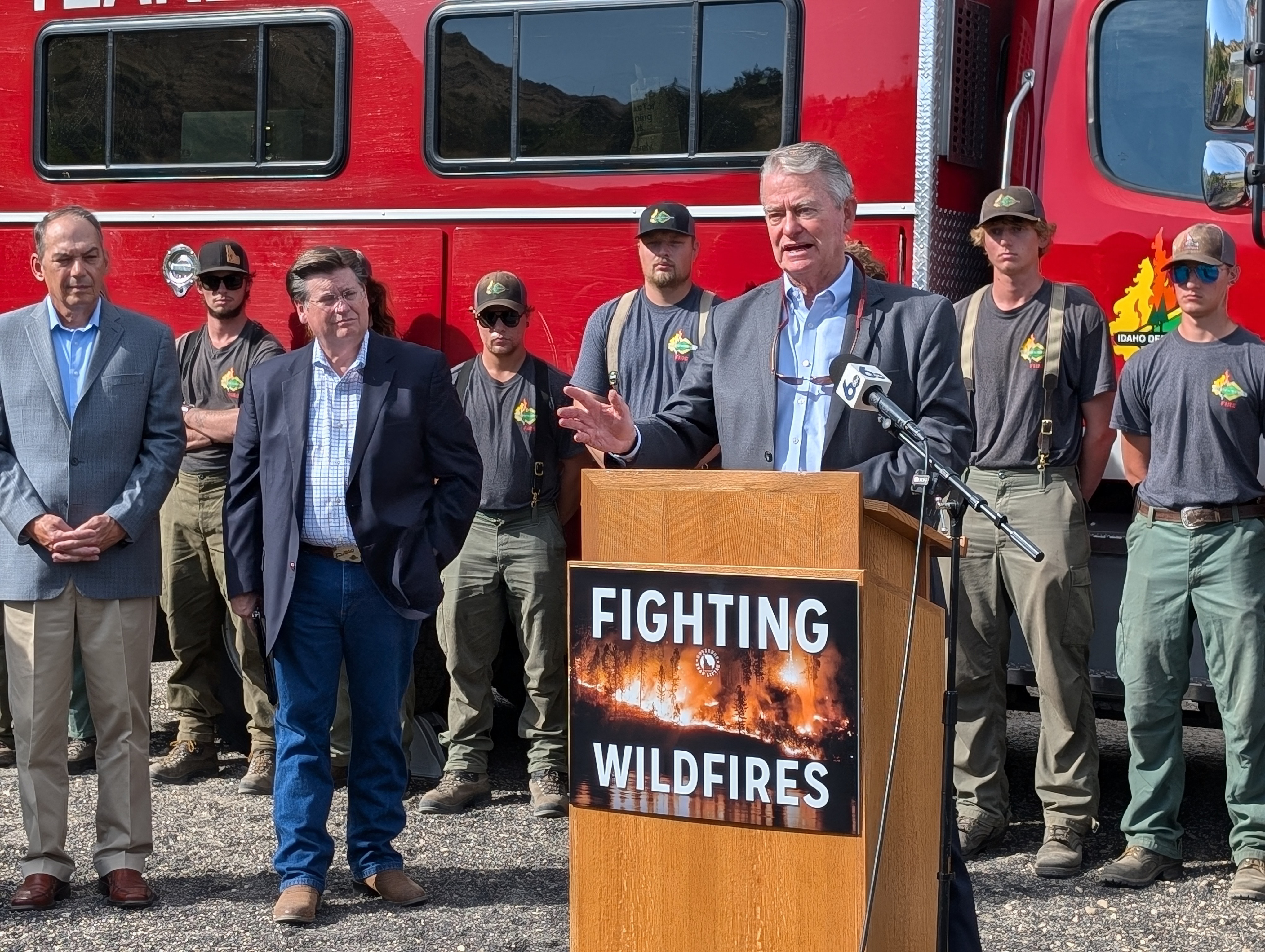
Flanked by first responders and division heads, Gov. Brad Little introduced a new report on Friday with recommendations and directives on wildfire suppression, including better managing fire fuels, improving statewide emergency response communications, and proposing legislation on wildfire liability standards for utilities.
The Friday morning press conference happened as the city of Stanley was under a level one evacuation warning – meaning get ready to go — while residents west of town received an immediate level three evacuation order Friday morning.
According to the Idaho Mountain Express, the go-now evacuation zone includes five subdivisions. The Wapiti Fire was at about 36,000 acres as of noon Friday, and was advancing east in the direction of Stanley. Highway 21 was closed east of Lowman from the Warms Springs Airstrip Road to Stanley, as of 2 p.m. Friday, due to the wildfire.

Meanwhile, much of southern Idaho was under a red flag fire weather warning from the National Weather Service, with wind gusts forecasted to hit up to 40 miles per hour and low humidity contributing to a dangerous wildfire situation.
The governor’s recommendations come after Little and Lt. Gov. Scott Bedke hosted a wildfire roundtable in 2023 with industry leaders to discuss emergency communications, reform for utilities and insurers, and strategies to prevent fires. Those strategies include encouraging fire-wise landscaping and construction for private property owners to reduce fuel loads, like dead trees and dry brush, on their land.
Department of Insurance Director Dean Cameron said he wants to keep insurance affordable for property owners and encourage them to be fire-ready. He discussed touring the aftermath of fires that burned homes in north Idaho last month.
“It was heartbreaking to go and see people’s homes, to see their belongings, their materials, reduced to sheer ashes,” said Cameron. “In some cases, in many cases, it looked like there could have been some prevention. I was also grateful, however, that we saw homes that weren’t burned because they did appropriate prevention.”
Cameron said he wants to retain all the property insurance carriers he can, knowing that the companies are wary after large catastrophic fires in other states.
Other recommendations included adopting a statewide notification and evacuation plan, identifying gaps in building codes, and finding grant sources to fund wildfire risk management. The reports states there also needs to be a statewide memorandum of understanding, or MOU, between state, federal, and local firefighting agencies.
The report mentions a plan to develop legislation to allow electric utilities more leeway on wildfire mitigation measures, including allowing them to more aggressively manage vegetation and remove at-risk trees within the designate areas where the utility does not currently have the right under existing permits.
“I think you’ll see a number of proposals from us and from others (in 2025),” Cameron said about possible legislation. “We want to help consumers be able to mitigate their own homes. We want to be able to help communities mitigate their own homes.”
This isn’t the first time Idaho has tried to get ahead of fire mitigation and suppression. Through the Good Neighbor Authority partnership with the federal government, the state has reduced fuel loads on some of the roughly 33 million acres of federal land in the state since 2017. And during the 2024 legislative session, the legislature approved $1 million in one-time bonuses for firefighters working for the Idaho Department of Lands after Little requested it in his budget.
On Friday, Little said stakeholders haven’t yet agreed on what next year’s legislation will look like.
“Every single person’s utility bill is going to be impacted by that,” Little said.
And the dynamic continues to change. Department of Lands Director Dustin Miller mentioned the impact Idaho’s growth has on fire.
“That growth puts more lives and homes in harm’s way,” said Miller. “Folks are building on the fringes of our forests and rangelands and within the wildland-urban interface.”
Miller said that creates more human-caused wildfires, and reducing that risk requires partnerships between local and state firefighters.
“No agency can do this alone,” he said.

Ruth Brown | Producer
Ruth Brown grew up in South Dakota and her first job out of college was covering the South Dakota Legislature. She’s since moved on to Idaho lawmakers. Brown spent 10 years working in print journalism, including newspapers such as the Idaho Statesman and Idaho Press, where she’s covered everything from the correctional system to health care issues. She joined Idaho Reports in 2021 and looks forward to telling stories about how state policy can impact the lives of regular Idahoans.